

Balcony Curtains Ideas for Style and Privacy
Autor: Laura Jorge
7 Minute(s) to read / 28.9.2026


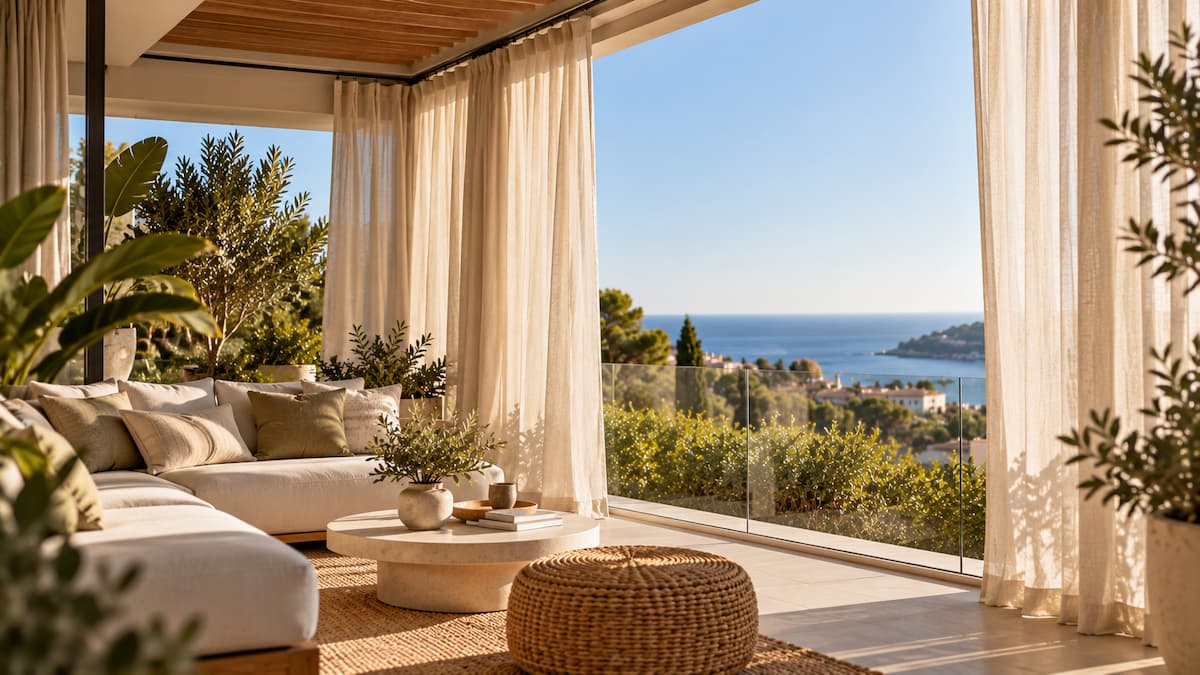
The best balcony curtains ideas solve two problems at once: they make an outdoor space look considerably more elegant and they give you privacy whenever you want it. A balcony can be one of the most enjoyable parts of a home, yet neighbours, nearby buildings, strong sunlight and wind often get in the way of using it comfortably. Fabric is the simplest answer, because it can be opened, closed, gathered or layered depending on the moment.
Why Curtains Work So Well Outdoors
Outdoor architecture is built from hard surfaces: stone, concrete, glass and metal. Curtains introduce softness and movement, turning a balcony into something closer to an outdoor living room than an architectural ledge.
They also filter direct sunlight and reduce glare, which matters on terraces exposed to several hours of sun. Unlike a fixed screen, fabric is reversible: closed when you want shade or seclusion, open when you want the view back. Many of the most effective balcony curtains ideas combine fabric with a structure, whether that is a pergola, a canopy or a simple ceiling-mounted rail.
Finally, curtains can divide one large balcony into zones: a shaded lounge on one side, a private dining corner on the other.
Balcony Curtain Ideas for Privacy
Privacy is the reason most people start looking at outdoor fabric in the first place.
The key principle is selective coverage. Instead of enclosing the whole balcony:
· Cover only the sides facing neighbouring apartments or the street.
· Keep the main outlook open.
· Remove unwanted sightlines without sacrificing the view.
For denser screening, semi-opaque technical fabrics provide more privacy without making the space feel heavy. For something lighter, perfect voile curtains create a visual filter that softens shapes rather than completely hiding them, which is usually enough during the day.
Bedroom balconies deserve particular attention. Panels installed around the perimeter, or directly outside the doors, can:
· Create separation from close neighbouring buildings.
· Maintain the connection to the outdoors.
· Make the space feel more private without fully enclosing it.
Choose a fabric with subtle texture rather than a flat, plain material. The result will feel intentional and integrated into the balcony design rather than improvised.
Balcony Curtain Ideas for Living Room
When the balcony opens off the living room, treat it as a continuation of the interior rather than as a separate project. Coordinate the outdoor fabric with the colours and textures already used inside. For example, cream panels outside a living room with cream curtains and beige upholstery help both areas read as one continuous space.
To create a more complete outdoor living area, add:
· Comfortable seating and cushions.
· An outdoor rug.
· Warm, ambient lighting.
With these elements in place, the curtains stop feeling like a simple privacy solution and become part of the overall design.
Full-height panels can also strengthen this effect by:
· Creating vertical lines that make the balcony feel taller.
- Visually connecting the outdoor area with full-height interior glazing.
Among balcony curtains ideas for living areas, made to measure curtains are usually worth the extra cost. Outdoor openings are rarely standard, and getting the exact drop and proportions right is what makes the installation feel designed rather than adapted.
Creative Curtain Hanging Styles
How the fabric is hung changes the result as much as the fabric itself.
Around a pergola
Pergolas provide the ideal structure for outdoor panels, which can run along the sides and be opened or closed according to the weather and the time of day. Bioclimatic pergolas take this further, pairing adjustable slats overhead with fabric at the sides so you can control light and privacy independently. For contemporary properties, minimal tracks and clean-lined fabric keep the look architectural.
Tracks and hardware
The track is the most overlooked part of the installation. It should run smoothly, suit exterior conditions and be positioned so the panels open without colliding with furniture. On ceilings, beams or pergola frames, placement determines how usable the whole balcony feels. Electric tracks add remote or smart-home control, which is genuinely useful when panels are heavy, numerous or hard to reach.
Tie-backs and gathering
Tie-backs are the cheapest way to make one installation behave in two different ways: gathered neatly at the sides for openness, released across the balcony for shade or seclusion. Rope and textile hardware suit relaxed interiors; discreet metal or integrated fixings suit contemporary ones.
Thematic Curtain Ideas for Balconies
A clear colour and material theme stops a balcony from looking like a collection of separate purchases.
Soft neutrals
Warm white, ivory, sand, beige, taupe, stone and natural linen tones sit beautifully with terracotta, wood, rattan and greenery. Neutrals also stay in the background, letting furniture, plants and the surrounding landscape carry the scheme. These are the safest of all balcony curtains ideas and the hardest to get wrong.
Considered colour
Soft terracotta, olive green, muted blue, dusty rose or warm ochre introduce personality without dominating. The rule is balance: if the furniture and cushions are already colourful, keep the fabric neutral; if everything is pared back, the curtains become the accent.
Dining and evening atmosphere
Panels around an outdoor table create an intimate setting for dinners. Combine them with pendant lights, wall lights or lanterns, and white or ivory fabric will reflect warm light in a way that needs almost no additional decoration.
Choosing Outdoor Fabric
Indoor textiles rarely survive permanent exterior use. Balcony panels face UV radiation, humidity, wind, dust, temperature swings, salt air near the sea and occasional rain.
Technical outdoor fabrics resist fading, moisture and general wear far better, and near the coast that difference becomes obvious within a season. Choose hardware rated for exterior use too, and follow the manufacturer's care instructions rather than cleaning outdoor fabric like an indoor curtain.
Dealing With Wind
Wind is the factor most often underestimated. Fabric that hangs perfectly indoors can become unmanageable on an exposed balcony.
Curtain weights, bottom guides, tie-backs and specialised outdoor tracks all improve stability. On very exposed balconies, the better solution is layering: a structured system such as an outdoor blind or vertical screen handles the functional load, while the fabric contributes atmosphere and softness. Practical balcony curtains ideas always account for how the fabric behaves on a windy evening, not only how it looks on a still afternoon.
Small Balconies
A large terrace is not a requirement. On a compact balcony, a single panel or a pair of lightweight ones can create a secluded corner without closing the space in.
Cover only the sides where privacy actually matters, pair the fabric with compact furniture, potted plants and soft lighting, and keep the palette simple. Restraint is what makes a small balcony feel bigger.
Questions Before You Choose
- How much privacy do you need? More privacy means a denser or semi-opaque fabric.
- How much sun does the balcony receive? Strong exposure favours technical solar-protection textiles.
- Is the balcony exposed to wind? If so, plan the track, bottom fixings or a complementary screen.
- How close is the sea? Coastal locations demand durable fabric and hardware.
- What is the style of the property? The fabric should extend the architecture, not contradict it.
Final Thoughts
Fabric is one of the simplest ways to transform an outdoor space. It provides privacy without a permanent barrier, softens hard lines, filters sunlight and makes a balcony genuinely comfortable to use.
The installations that work best are those where fabric, colour, track, fixings and overall design were planned together rather than added one at a time. At Arte del Lusso, outdoor spaces receive the same attention as interiors, so a balcony becomes a private, comfortable extension of the home rather than an afterthought. Style and privacy do not have to compete: with the right materials, you can have both.